#48 Backstory of the Poem “Laika” from the poetry collection OBSCURA by Frank Paino published by Cleveland State University Poetry Center on December 5, 2020 and Gettysburg Review 29:3 (Winter, 2017)
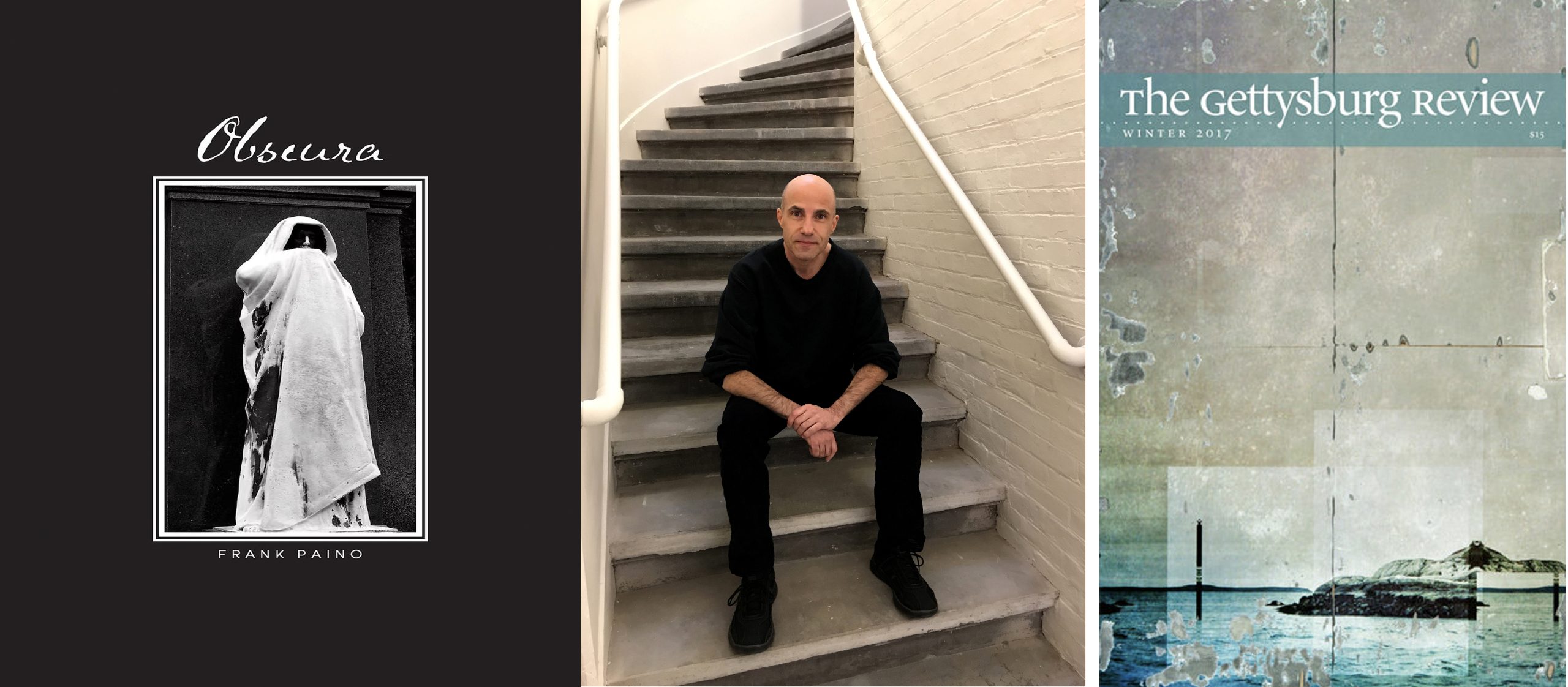
#48 Backstory of the Poem “Laika” from the poetry collection Obscura by Frank Paino
published by Cleveland State University Poetry Center on December 5, 2020
and Gettysburg Review 29:3 (Winter, 2017)
https://www.csupoetrycenter.com/
http://www.gettysburgreview.com/
Can you go through the step-by-step process of writing this poem from the moment the idea was first conceived in your brain until final form?
I suppose the moment I first learned about Laika, who was the first dog to be launched into low earth orbit, I knew I’d write about her one day. That being said, I honestly don’t remember when I first read about her, so I can’t say how long it was between that first encounter and the poem’s creation.

Regarding “final form,” I’ll say I subscribe to Valéry’s view that “A poem is never finished; it is only abandoned.” Each time I read one of my poems I find myself wanting to change something here or there. So let’s just say “Laika,” like all of my writing, is subject to change.
https://www.poetryfoundation.org/poets/paul-valery

Where were you when you started to actually write the poem? And please describe the place in great detail.
I’d taken the day off work to try and write. It was a Friday and I was in my writing room, which is a rather large space (14 x 12) on the second floor of my house. It’s carpeted (though I would much prefer hardwood). It’s somewhat sparsely furnished with my desk and chair, a wingback chair, bookcase, lamp table and large cabinet/dresser. Three walls are painted a colour called “Sensational Sand” and there is an accent wall in “Reddened Earth.” The room has two windows, one of which is to my left and behind me as I sit at my desk. The other window is to my right as I sit at my desk—it allows me to look out onto green space, tree branches, and a neighbouring house a little distance off.

As far as decorations, I have:
Clay, handmade Tragedy and Comedy faces purchased by my father on one of his trips back to his native Sicily. He bought them from a street vendor and was very fond of both. I adored my father, so it’s very meaningful for me to have something he cherished in a place that represents who I am as both a poet and person

Beneath the little masks is a framed print of one of his favourite poems, “The Infinite” by the Italian poet and philosopher, Giacomo Leopardi. An acquaintance copied the poem in exquisite calligraphy in the original Italian, and the English translation is typed beneath that. I don’t want to go into an explication of the poem, but because he loved the piece, it offers insights into my father that I find beautiful and sad at the same time.
https://www.giacomoleopardi.it/en/life-and-works/#
https://www.poemhunter.com/poem/the-infinite-2/

I also have a framed, shadowboxed, flying lizard from Indonesia and, next to him, a framed, shadowboxed, set of three beetles, also from Indonesia
I’ve got my framed diploma from Norwich University’s,Vermont College (where I earned my MFA in 1990)

Draped on the side of the frame is the medal I was given when I was awarded the Cleveland Arts Prize in Literature in 1994
Then there’s a wall niche with a reproduction of Mucha’s sculpture, “Nature”
https://www.muchafoundation.org/en/gallery

Behind my desk is a large, framed print of the Haserot Angel (a famous bronze memorial sculpture at Cleveland’s Lake View Cemetery)
https://en.wikipedia.org/wiki/The_Angel_of_Death_Victorious
https://grokipedia.com/page/herman_matzen
https://grokipedia.com/page/herman_matzen

I also have a set of Asian-themed wind chimes
Next to that is a large, signed and framed print of “Blind Narcissus” by the artist, Jeff Jones
https://en.wikipedia.org/wiki/Jeffrey_Catherine_Jones

I also have a near life-size stuffed Rottweiler named “Damien”
On top of the dresser/armoire is a reproduction of a 9th or 10th century sculpture of the Hindu goddess, Uma
https://en.wikipedia.org/wiki/Uma%E2%80%93Maheshvara
On top of my bookcase is a polystone reproduction of a mourning Victorian angel cemetery sculpture

On my bookcase itself is a white polystone Buddha in a pose conveying protection and overcoming fear

There’s also a skull in a shadowbox frame. I regard him as both my muse and a memento mori

Finally, I have two small pewter phoenix birds. I think of the phoenix as a personal totem/symbol that reminds me to be resilient and to never, ever surrender
On my lamp table is:
A lamp (what a surprise)
A figurative, aluminum horse sculpture my twin sister gave me decades ago. A box with a hedgehog design which was packaging for a coffee mug my sister also gave me

On my desk is:
A bronze sculpture by Heather Johnson Beary (“Eternal Flame”)

A tiny silver piece depicting a human figure in the “child” yoga pose. This was given to me by a dear friend
A tiny bronze snail given to me by another friend

Speakers
A high-intensity light
A snowman snow globe

A pin featuring the death mask of the unidentified woman whose face was used as the model for the first CPR doll (given to me by a dear friend)
Last, but certainly not least, my 27” iMac
The lion’s share of the bookshelf is comprised of my poetry collection and books on various Victorian-Era cemeteries (an obsession of mine), but there’s also a nice selection of books I would describe as being concerned with what I will call “the unusual.” Finally, there’s a very small fiction section.

What month and year did you start writing this poem?
All of my poems begin with a pen and paper. I keep a notebook for this purpose, so I can say with certainty I began writing the poem on the 10th of March, 2017.

How many drafts of this poem did you write before going to the final?
I really can’t say how many drafts I wrote. Once I have a solid start, I move to working on my computer and I don’t keep track of versions but, rather, simply keep revising the one so that it transforms as I work.

Were there any lines in any of your rough drafts of this poem that were not in the final version? And can you share them with us?
There were plenty! Most are lost because they were changed as I went along on the computer and I don’t keep track of the evolutions.
As for lines I do know I had—most are too embarrassing to even admit to… but I’ll humiliate myself by giving you one that is on the page I photographed: “In the pale wash of moonlight,” which is so trite and clichéd. Sheesh! But you can also see most (all?) of the writing is bad—scattered, uninventive, lost—but searching!

This, and all the other instances of truly terrible writing I “commit,” is a perfect example of what happens in the revision process—which is, for me, what writing is really all about. I simply adore revising and can spend untold hours at it. I look for clichés, easy language, awful and/or awkward similes, metaphors and syntax. I play with form and punctuation and keep trying to push the boundaries of the poem further. This is the time when my head really gets into the eye of the hurricane, so to speak—a place where all the noise and tumult vanishes and my mind has free rein to associate the seemingly unassociated. It’s a place where surprises happen!
Revising is largely a very fun endeavor for me, though, after a few days of working on a single poem nearly non-stop, I can relate to a quote that is (perhaps apocryphally) attributed to Oscar Wilde: “I spent all morning putting in a comma and all afternoon taking it out.”
https://www.oscarwilde.fr/Site_officiel_dOscar_Wilde/Oscar_Wilde.html

What do you want readers of this poem to take from this poem?
For me, the question is more properly stated as what I hope a reader will take from the poem…that being said, here’s what I‘ll say about this question. . .Of course, I want to tell Laika’s story… but I also know that, on the face of it, most people would tend to vilify Dr. Yazdovsky and leave it at that. In this piece; however, I hope to convey he wasn’t an inhumane monster. The poem’s epigraph is indicative of this, but, really, for me, it’s the fact he was so insistent on adding a window to Sputnik 2. Misguided as it may have been, he wanted to give Laika something he thought might soothe her on her final, horrific journey. Rather than being in a dimly-lit capsule, she’d at least be able to see something. Granted, I doubt that was really of any comfort to her, but I think that’s beside the point. It’s his intention that counts. And that goes for taking Laika home so she could play with his daughters, too.
On a larger scale, I hope the poem encourages people to avoid quick judgments and black-and-white answers, because neither is helpful.

Which part of the poem was the most emotional of you to write and why?
That’s a difficult question because the entire story is so appalling and heartbreaking. But when I really stop to think about it, it would have to be:
…no way to make right
the trust that was betrayed—
the muzzle and mad tongue of it—
I suppose that’s the worst part of Laika’s story. I can’t claim to know the level of sentience dogs have, but I am confident they understand love and kindness. I’m sure Laika came to trust Dr. Yazdovsky, regardless of the small enclosures he put her in, the loud noises he accustomed her to, etc.. He still fed her, played with her, petted her, etc.. Betraying that trust is the most terrible and tragic aspect—even beyond what I am sure were the appalling final moments of her life.

But again, Yazdovsky wasn’t a heartless man. In fact, in his later years he admitted one of the things he regretted most in his life was sending Laika to such a terrible death. But he was a scientist and also a man (among others, of course) under incredible pressure, having been commissioned by Khrushchev to get Sputnik 2 designed, built and ready to launch in only four weeks… and with a live animal on board that could not only survive the launch, but also endure long enough to provide (via attached equipment) crucial data about the physiological impact of travel at that distance above the earth. As I understand it, the plan was not to leave Laika to die from the heat/fire inside the capsule. There are various versions of the story—but all seem to agree the scientists knew she would never come back alive, but the intention was to somehow kill her painlessly after some time, either with sedative-laced food or water, or even some sort of mechanism that would deliver a lethal injection.
Anything you would like to add? The most important person in my life is my twin sister, Gerrie. We have a bond that is magical, irrevocable and profound. Other than that, I have a handful of dear friends who give my life another dimension and richness I cherish.

Also, Thanks to Luke Hankins editor extraordinaire and all-around great guy, my third book, Obscura, is from Orison Books.
https://www.orisonbooks.com/product-page/obscura-poems-by-frank-paino

Other than that, I simply want to thank you for inviting me to share my work and be a part of your “Backstory of the Poem” Series.
https://www.facebook.com/frank.paino.poet

001 Backstory of the Poem
“12 – 2014” from the poetry collection BEFORE THE DROUGHT by Margo Berdeshevsky published by Glass Lyre Press on September 15, 2017
#002 Backstory of the Poem
“82 Miles from the Beach, We Order The Lobster At Clear Lake Café”
by Alexis Rhone Fancher
#003 Backstory of the Poem
“Orange”
by Barbara Crooker
https://christalcooper.com/003-backstory-of-the-poem-orange-by-barbara-crooker/
#004 Backstory of the Poem
“Modern Matsushima”
by Sonia Saikaley
https://christalcooper.com/004-backstory-of-the-poem-modern-matsushima-by-sonia-saikaley/
#005 Backstory of the Poem
“Side Yard”
By Ellen Foos
http://chrisricecooper.blogspot.com/2018/01/5-backstory-of-poem-sidewalk-by-ellen.html
#006 Backstory of the Poem
“The Ringmaster”
By Susan Sundwall
https://christalcooper.com/006-backstory-of-the-poem-the-ringmaster/
#007 Backstory of the Poem
“That Night”
by Leslea Newman
https://christalcooper.com/007-backstory-of-the-poem-that-night-by-leslea-newman/
#008 Backstory of the Poem
“June Fairchild Isn’t Dead”
by Alexis Rhone Fancher
#009 Backstory of the Poem
“The Gift of the Year with Granny”
By Charles Clifford Brooks III
#010 Backstory of the Poem
“The Natural Reflection of Your Palms”
by Scott Thomas Outlar
https://chrisricecooper.blogspot.com/2018/03/chris-ricecooper-caccoopaol.html
#011 Backstory of the Poem
“After Diane Beatty’s Photograph “History Abandoned”
by Anya Francesca Jenkins
#012 Backstory of the Poem
“What I Learned This Week”
By Angela Narciso Torres
#013 Backstory of the Poem
“Holidays On ICE”
By Jan Steckel
https://christalcooper.com/013-backstory-of-the-poem-holiday-on-ice-by-jan-steckel/
#014 Backstory of the Poem
“Colors”
by Ibrahim Honjo
https://christalcooper.com/014-backstory-of-the-poem-colors-by-ibrahim-honjo/
#015 Backstory of the Poem
“Ode To Disappointment”
By Marilyn Kallett
https://christalcooper.com/015-backstory-of-the-poem-ode-to-disappointment-by-marilyn-kallet/
#016 Backstory of the Poem
“Reliquary”
by Beth Copeland
#017 Backstory of the Poem
‘The Swallows of Barcelona”
by Marlon L. Fick
https://christalcooper.com/17-backstory-of-the-poem-the-swallows-of-barcelona-by-marlon-fick/
#18th Backstory of the Poem
“Arterial Discombobulation”
by Juliet Cook
#19th Backstory of the Poem
“Stiletto Killer . . . A Surmise” from the poetry collection ENTER HERE
By Alexis Rhone Fancher
#20 Backstory of the Poem
“At Last I Can Start Suffering”
By Charles Rammelkamp
#21 Backstory of the Poem
“Wind Chimes”
by Marla Shaw O’Neil
#022 Backstory of the Poem
“Studying Ariel”
by Julia Gordon-Bramer
https://christalcooper.com/22-backstory-of-the-poem-studying-ariel-by-julia-gordon-bramer/
#023 Backstory of Poem
“Jesus Zombie”
by Bill Yarrow
https://christalcooper.com/23-backstory-of-the-poem-jesus-zombie-by-bill-yarrow/
#24 Backstory of the Poem
“Brag 2016:
by Telaina Eriksen
#025 Backstory of the Poem
“It is only Yourself that Bends – so Wake up!”
by Seth Berg
#26 Backstory of the Poem
“Devil In the Details”
by David Herrle
https://christalcooper.com/26-backstory-of-the-poem-devil-in-the-details-by-david-herrle/
#27 Backstory of the Poem
“Carmen Polo, Lady Necklaces, 2017”
by Gloria Mindock
#28 Backstory of the Poem
“Two Deaths”
by Connie Post
https://christalcooper.com/28-backstory-of-the-poem-two-deaths-by-connie-post/
#029 Backstory of the Poem
“Faces in a Crowd”
by Mary Harwell Sayler
#030 Backstory of the Poem
“The Risking Point”
by Larry Jaffe
#031 Backstory of the Poem
031 September 24, 2018
Mark Lee Webb’s “After We Drove”
https://christalcooper.com/31-backstory-of-the-poem-after-we-drove-by-mark-lee-webb/
#032 Backstory of the Poem
“Astral”
by Melissa Studdard
https://christalcooper.com/32-backstory-of-the-poem-astral-by-melissa-studdard/
#033 Backstory of the Poem
“I Have A Bass Guitar Called Vanessa”
#034 Backstory of the Poem
David Sullivan’s “Paper Mache Peaches of Heaven”
https://christalcooper.com/34-backstory-of-the-poem-paper-mache-peaches-of-heaven-by-david-sullivan/
#035 Backstory of the Poem
“Sobriety”
by Timothy Gager
#036 Backstory of the Poem
“The Second Breakfast”
by Gary Glauber
https://christalcooper.com/36-backstory-of-the-poem-the-second-breakfast-by-gary-glauber/
#037 Backstory of the Poem
“Melania’s Deaf Tone Jacket”
By Heather McKeon
https://christalcooper.com/37-backstory-of-the-poem-melanias-tone-deaf-by-heather-forbes-mckeon/
#038 Backstory of the Poem
“Women of the Fields”
by Andrena Azwinski
#039 Backstory of the Poem
“Poe”
by Gordon Hilgers
https://christalcooper.com/39-backstory-of-the-poem-poe-by-gordon-hilgers/
#040 Backstory of the Poems
“My Children Question Me About Poetry” and “Deathbed Dreams”
By Rita Quillen
#041 Backstory of the Poem
“Dog Sitting”
by Jonathan Kevin Rice
https://christalcooper.com/41-backstory-of-the-poem-dog-sitting-by-jonathan-kevin-rice/
042 Backstory of the Poem
“Mountain”
by Haroldo Barbosa Filho
https://christalcooper.com/42-backstory-of-the-poem-mountain-by-haroldo-barbosa-filho/
042 Backstory of the Poem
#43 Backstory of the Poem
“Grief Flowers” from the anthology ‘
by Megan Merchant
https://christalcooper.com/?p=1881&preview=true
#44 Backstory of the poem
“This Poem is too Neat”
By Jonathan Taylor
#45 Backstory of the Poem
“Sungmyo for our Dead Father-in-Law
by Ian Haight
#046 Backstory of the Poem “Poem Registering in the Throat” from the poetry collection INNERMOST SEA, by Nancy Dafoe and published by Finishing Line Press on November 30, 2018
#47 Backstory of the Poem
Jeffrey Owen Pearson’s “Memorial Day” from the poetry anthology Best of Flying Island, published on March 21, 2014
and in Indiana Humanities on April 13, 2016